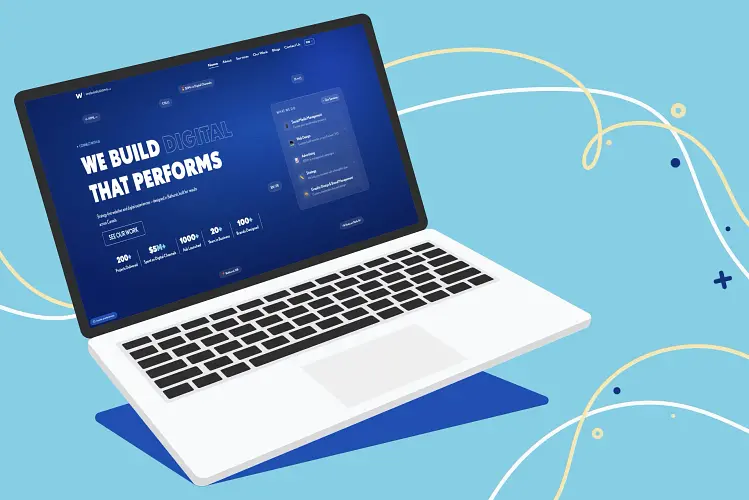
Websolutions.ca has been around for over two decades, and in that time, we've had a front-row seat to one of the most dramatic transformations in the business world: the evolution of the company website. Not just how they look, but what they do, what businesses expect from them, and what happens when they fall short.
What started as simply "being online" has become one of the most consequential decisions a business can make in 2026. But how did we get here?
In this blog, we're taking another trip down memory lane alongside Websolutions.ca founder and President, Josh Gammon, recounting our first-hand perspective of how websites have evolved over the last 20 years.
Back in Our Day
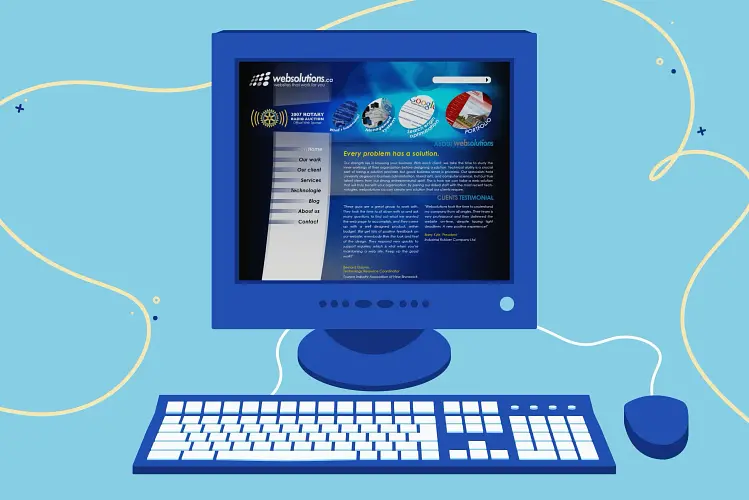
If you've ever stumbled across a website from the early 2000s, you already have a sense of how different things were back then. Most sites at that time were as basic as it gets: a few static pages, some text, maybe a photo or two, and not much else. Analytics were nonexistent (unless you count the animated hit counter proudly displayed at the bottom of every page), interactivity was minimal, and the idea of a "strong" website simply hadn't been invented yet.
Back then, the main purpose of a website was visibility. A company website essentially acted like an online billboard; a place to post your address, phone number, and a list of services. No online booking, chatbots or e-shopping in sight. Getting one wasn't cheap, either, meaning the barrier for entry was high. Every page had to be coded from scratch using text editors like Notepad++ and designed with programs like Microsoft FrontPage, which meant any update, no matter how small, required a developer to step in. That made ongoing maintenance expensive and largely out of reach for many smaller businesses.
"Our designer at the time was all-in on tables and cells for layout, with spacer GIFs and fixed widths built for 800x600 screens. Lots of Flash. Stock photography was either hard to find or expensive; it was a different world."
— Josh
That changed in 2003 with the launch of WordPress, the first widely accessible Content Management System (CMS). For the first time, business owners could update their own websites without writing a single line of code. Here at Websolutions.ca, Josh was already ahead of the curve: just one year later, he built the very first iteration of our own CMS, "wsCMS," which powered our earliest PHP projects and websites.
From here, Josh went on to build some of Websolutions.ca’s first websites for clients like Maritime Welding and Industrial Rubber (and, of course, ours).
"Our first real 'big' job was the Rogers Electric Motor Management System, and even that was only around $5,000. It was a full custom PHP web app: an admin side with motors, frames, horsepower, bearings, estimates and reports; a client portal with work orders and motor history; and, in later versions, a live shop-floor status board showing each motor's stage and percent complete. Serious web-app work at a time when most shops were still putting up digital brochures."
— Josh
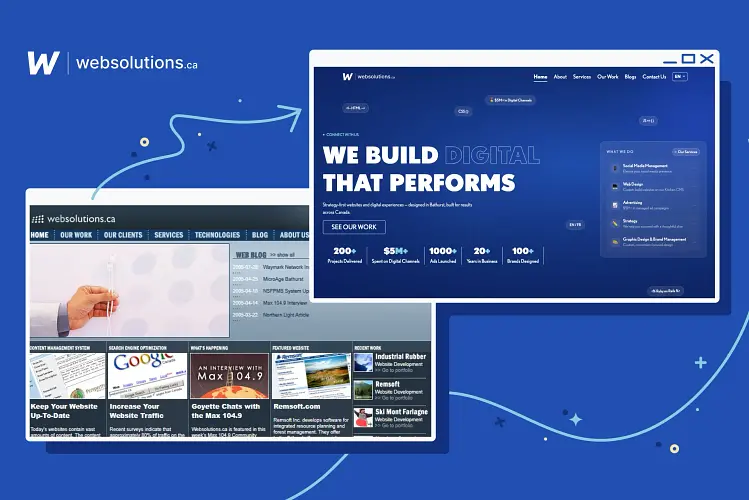
How We Got Here
Throughout the 2000s and into the 2010s, the idea of a website would see a near-complete transformation. One of the most impactful changes was the quiet shift from table based layouts to Cascading Style Sheets (CSS), which allowed for design and content to finally be managed separately, and for contact forms to replace “email us” links.
When mobile took over, websites built for desktop screens suddenly looked broken when seen on a phone. The short-term fix was a separate "mobile version" of your site (in our case, literally "m.websolutions.ca"), which was a maintenance nightmare. The real fix came around 2010 with responsive design: one website that automatically adapts to any screen size. As mobile continued its rise in popularity, responsive design became the baseline every website had to follow.
The mobile takeover doesn’t stop there: when Google shifted to mobile-first indexing in 2016, it began ranking websites based on how they performed on a phone rather than a desktop. A slow, clunky mobile experience suddenly translated into lower search rankings and fewer customers finding you. Technical quality became more than an internal developer issue; it was now a legitimate business concern.
This led to the rising importance of web accessibility. Following the release of the Web Content Accessibility Guidelines 2.0 (WCAG 2.0), businesses had a more concrete understanding of how to make their websites usable across platforms. Today, web accessibility is the standard, and websites that don’t meet the WCAG guidelines are heavily penalized by search engines. To find out how we champion web accessibility, check out our other blog!
Search Engine Optimization (SEO) followed a similar arc. What started as keyword stuffing and algorithm tricks eventually turned into a genuine discipline: content quality, site speed, security, and user experience all now impacted where your website ranked in search results. Google's Core Web Vitals formalized this further with measurable benchmarks for page load speed and layout stability. Now a website that took too long to load would be penalized in search results, which directly impacted how businesses established and maintained their visibility online.
These changes began the trend of websites maturing towards a new standing in the professional world. Suddenly, a poorly optimized website wasn't just an afterthought; it was a visible sore spot that businesses needed to address.
Something else changed during this period that doesn't get talked about as much: the way we pay for technology. In the early days of the web, most software was buy and forget. Adobe Creative Suite shipped on a stack of CDs, QuickBooks was localized on your desktop. Payment gateways were a multi-week integration project. Your business email was a free Gmail account with the company name wedged in front of it. You paid someone to build you a website, and that was more or less it.
Slowly but surely, the whole industry shifted to subscriptions. Hosting, CMS platforms, email tools, analytics, security certificates; all of this and more became things you rented rather than owned. For businesses, that means lower upfront costs but ongoing monthly commitments, and a website that requires continuous investment to stay current.
The upside is that the barrier to entry is significantly lower today than it once was. Small businesses can now access tools that were once reserved for companies with serious budgets, which has leveled the playing field in ways that simply weren't possible 20 years ago.

What a Website Does Now
The company website of today looks very different from the one 20 years ago, and what businesses expect from it has changed just as dramatically.
The do-it-once-and-forget digital brochure of the 2000s is no more. A modern website is expected to function more like an employee: generating leads, building credibility, ranking on Google, converting visitors, and integrating with the broader marketing and sales tools a business depends on.
Most consumers these days research a business online before making a purchase, and a Stanford Web Credibility study showed 75% of consumers judge a company's credibility based on its website alone. In 2004, not having a website was forgivable and understandable for smaller businesses. Today, not having one (or having a bad one) can actively work against you.
Analytics are now standard for websites across industries. Business owners today expect the ability to track who's visiting, where people are dropping off, and what's actually converting. Thanks to platforms like Amazon, E-commerce and self-serve functionality have become the new norm. For many, the idea of purchasing, booking, and engaging a business over the phone is antiquated. When customers land on your website, it’s like someone walking into your store and being greeted by a receptionist. The classic adage remains true: first impressions are everything.
The newest piece of this puzzle is AI, and it's already reshaping what a competitive website looks like at breakneck speeds. Chatbots that handle customer questions around the clock, personalization engines that show different content to different visitors, and tools that help teams produce more content faster are all becoming part of the baseline expectation. It's still in its early days, but it's already had a dramatic impact on businesses everywhere.
"The newest shift is AI on both ends: we use it to help build, and we structure content so AI search tools and assistants can actually find the business; clear answers, FAQ sections, schema markup. The company website is no longer a brochure."
— Josh
What feels cutting-edge today will likely be the standard in a few years, just like responsive design and SEO during their rise in popularity. The businesses adapting now will feel the least disruption when it eventually becomes the norm.
All of this adds up to something that would have seemed impossible to a business owner in 2004: a website that works for you around the clock, handles first impressions before any human is involved, and either builds or destroys trust in seconds. That's why how it's built, and who builds it, has never mattered more.
At Websolutions.ca, we've been building websites through all of these changes, from the hand-coded days of the early 2000s to the AI-influenced landscape of 2026. We didn't read about any of this shift; we built and grew around it. If you want a website made by people who understand what a modern website needs to be, reach out today. We'd love to talk!